

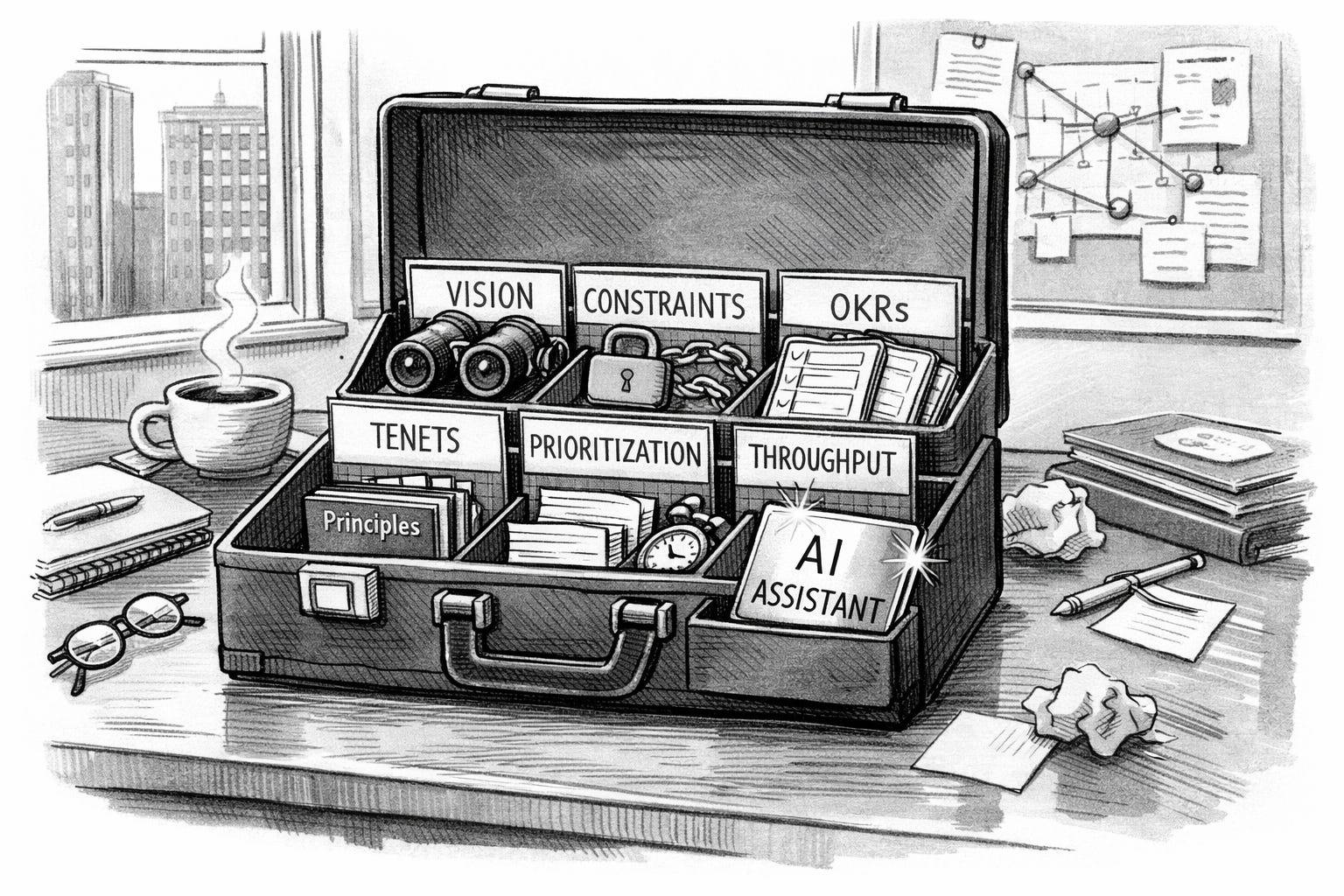
TLDR; I’ve had positive feedback on writings over the past year that shared systems to sharpen what’s important for your team, structure tenets and OKR’s around that clear vision, and use “time” as a common currency to align interests. I wanted to build something that could reinforce those skills - but keep it grounded in asking questions. Not handing over the controls fully to an AI that will boil everyone’s problem to the same generic solutions. I’ve got something that’s been personally useful, far from perfect, but why not share the work in progress?
Things besides hearing my voice in a podcast that make me cringe
I’ve been told that my former colleagues at Stitch Fix have a set of “Rich-isms” that get referred to from time to time. While there are alternative explanations I’ve chosen to interpret that as a fondness tinged with a sadness due to my absence. As it turns out Stitch Fix was the job where I realized that a lot of the stories and frameworks derived from them have been playing on repeat in my head - articulating goals with a clear vision, how to set that vision in the customer’s world of problems, observable OKR’s grounded in controllable inputs, tenets to align, and so on. All of which was what prompted me to start writing this Substack. Well, that and an inability to get my shit together enough to put them together into a book1.
Those “Rich-isms” were stolen liberally from others who themselves had rediscovered common universal truths over the ages. A large majority of the stories I’ve been telling as part of my management career (outside of technical problems) match with one or more of these categories
Clarifying vision to have a shared expression of what success in the future looks like. Set in the needs of someone else such as your customer (aka; someone who is not you)
Finding the constraint - what’s the single bottleneck that is truly slowing the organization down. AKA; it’s not important to try to do everything, everywhere, all at once2.
Writing awesome OKR’s that align organizations top down on what needs to be true, while promoting maximum autonomy for teams on the “how” to achieve that. With the “how” being updated a lot more often than the “what.” Always expressed in controllable, observable inputs.
Forcing prioritization, otherwise people are gonna do too everything, everywhere all at once.3
Using Tenets to preload the decisions on recurring arguments and tradeoffs into operating principles. The /help function to understand your team’s API’s when it comes to controversial choices.
Building a living understanding of where a team’s time goes as a shortcut to where to find throughput. Also great to get your CFO super fired up about addressing tech debt.
This could sound familiar as I wrote on all of these at some point in the last year or so. The 6 segments aren’t a complete guide to everything in a recommended toolbox. It’s leaving out culture stuff, postmortems, premortems, and a bunch of other great tools. But if you could consistently and optimally use these tools it’s gonna result in a lot of goodness - and fun TBH.
Scaling
In an alternative universe I’d survive as a technical management soldier of fortune4. Going from one person or org in need to another - quickly helping put things on an improved path. I am to a lesser extent still available for that sort of thing, but I’m always looking to maximize scale, while still embracing laziness as a virtue.
I’ve been experimenting a bit with how to distill my ways of working (and writing) into something that’s more accessible. That included for me. It’s easy to get sucked into a problem and forget your own rules. With a new job I’ve felt myself slowing down to remember my own lessons as I worked up suggested tenets, and OKR’s to organize the firehose of information blasting me in the face.
At some point I felt I was in a lull building/playing with Claude Code. Since I was essentially wasting tokens I asked for help generating a set of prompts that would support each of the six key situations above. Pushing users through a working session to sharpen their team’s planning through defined stages. I’ve been trying them out on real work problems, and generally happy with the results. Next - I threw all of them into a custom GPT that I’m making available today.
I’d much appreciate your feedback if you give it a shot. I’m still definitely tuning things to provide the most helpful set of tools. It’s not perfect, especially in that it’s missing my off-putting voice asking the same things over and over such as;
“and what would have to be true for that to be a good idea?”
“if you envision all the core problems being solved overnight, and you came into work, how would you notice the miracle occurred?”
“What makes that good for the customer?”, and so on...
But it’s easier to get a hold of than I am, and a lot cheaper. Hopefully it might even convince a few people that the live experience is worth paying through the nose for. Feel free to reach out if I can help work through these sorts of problems interactively with you or your org.
Update: I’ve uploaded the underlying prompts to github so folks can use them with Claude, inside enterprise installs, and offer suggested improvements as they try them out.
You’ve got the link, so I’ll let the model introduce itself now
I’m a sharp, question-led thinking partner for tech leaders. I’m most useful when the problem is still fuzzy: clarifying a 12–18 month vision, finding the real constraint slowing a team down, turning that into 1–2 solid OKRs, cutting work down to a few real bets, sharpening operating tenets, or mapping where time actually goes. I do my best work with rough notes, half-formed instincts, and messy realities.
My style is direct, curious, and unsentimental. I won’t rush to tidy answers too early or generate strategy from thin air. I’ll usually ask a small number of pointed questions, push for specificity, surface contradictions, and help you say what you already know but haven’t pinned down yet. When needed, I can also help synthesize what’s been said into a clean artifact you can use with your team, but the main value is in helping you think clearly enough to make the hard call yourself.
One caveat is that I’ve noticed that enterprise versions of ChatGPT are usually locked down to prevent running a custom GPT. If you find it helpful and want to use it more broadly in your org just let me know.
Some additional feedback from the GPT itself
Use this like a thinking partner, not a content generator. Bring the problem early, while it is still messy. Share what is confusing, what feels contradictory, or what keeps getting re-litigated. The GPT will help you work through it with sharper questions, clearer framing, and more grounded tradeoffs.
Hope it’s helpful. And as always - thanks for reading.
Though I think I’ve got the through line for the book idea, which I’m returning to slowly. If you’re a unicorn that both loves my writing and has a great connect with a serious publisher then do shoot me a note.
I’ll keep pointing out that I didn’t love that movie as much as many - but boy, it’s a great phrase for a lot of situations.
see what I mean about that?
“if you have a problem, if no one else can help, and you can find him, then maybe you can hire…” Oh, sorry - that’s something else entirely