TOC's Critical Chain & Rules of Flow
The Musical

Backstory
This past week I’ve been re-reading Critical Chain, the Eliyahu Goldratt book that extended his work on theory of constraints (TOC) thinking systems. His daughter published the excellent sort of sequel Goldratt’s Rules of Flow - which took the same material (how to dramatically better manage projects) and simplified it. While incorporating the last two decades or so of thinking on Critical Chain Project Management (CCPM). I’ve read and reread Rules of Flow several times since its release. But it was 8-10 years since I reread Critical Chain. Having found myself in a business that did projects to specific time targets I suspected it was worth a refreshing of my understanding.
I’m so glad I went back to the source material. With a decade more experience with engineering projects in general and thinking about the importance of focusing on the key constraints of problems I got a lot more out of it.
I kept thinking how much unnecessary pain and suffering existed in the world just because these methods aren’t the default. Leaving many companies pushing people past the brink while still missing dates and complaining about throughout. Only to have each project feel like an episode of Gilligan’s Island (or Groundhog Day, or whatever expression Gen Z uses).
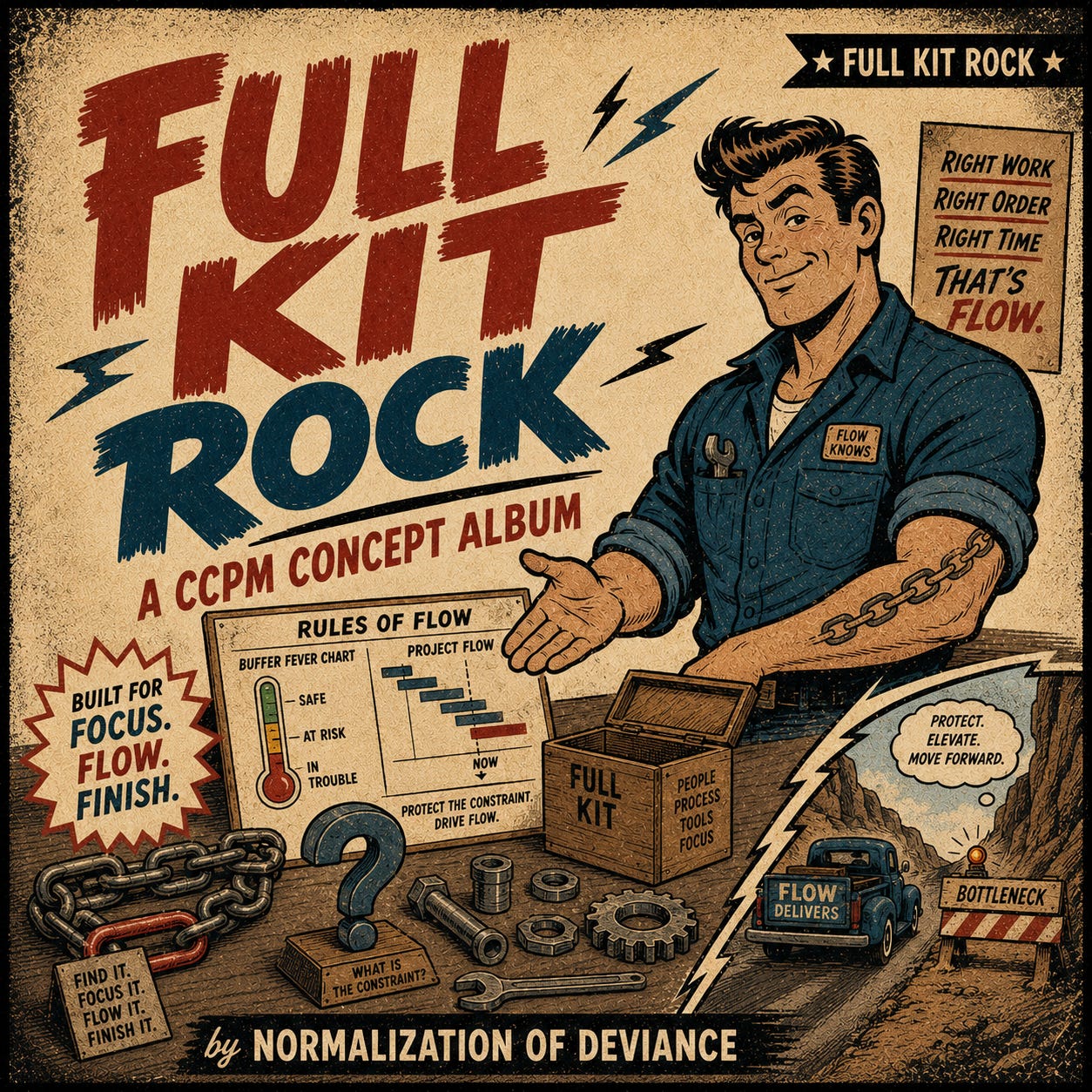
How could I get better at explaining these surprisingly simple but counterintuitive ideas to people? Then it hit me - Gen X can explain step by step how a bill becomes a law 40+ years after learning. More accurately they can sing the steps. Thus lightning bolt - FULL KIT ROCK - they key points of CCPM sung in the tradition of Schoolhouse Rock. Or as close as I can get current AI tools to get with no real effort on my part to learn how to get the sound vibes right.
Ok, maybe my nerdcore album from punk/country/metal band Normalization of Deviance put the idea in my mind. But whatever dude - you’re complaining about a succinct lesson in an incredibly powerful set of tools AND catchy songs to remember them?
that’s better … and again, YOU’RE WELCOME!
https://normalizationofdeviance.band/albums/full-kit-rock/
Don’t worry, if you’re not digging this theme I promise it will be a while until I do any more songs. I’ve got other non-musical ideas to share first
Masters of Flow
Want to take your projects to the next level? Want to listen to a catchy tune?
Like the Reese’s Peanut Butter Cups of getting stuff done, these things go together better than I expected. While I’m not going to lie and say I didn’t get some serious help from AI, it’s still pretty great to see some important ideas distilled down into short songs. Every one hand inspected and tuned by an actual human.
Thus Full Kit Rock was born: ten songs (plus a bonus track) designed to capture the essentials of Critical Chain Project Management (CCPM) and Goldratt’s Rules of Flow in plain language and catchy hooks. Plus a bonus track on building vision and alignment via questions (instead of telling). This album goes to 11, literally!
Below you’ll find a short primer on Critical Chain and the Rules of Flow, a link to one of my favourite chapters from Critical Chain, and a track‑by‑track tour of the album. My hope is that this serves both as an accessible introduction to Theory of Constraints and as an invitation to sing along while you rethink how projects get done.
Why Critical Chain and the Rules of Flow?
Goldratt’s core insight is simple: organisations are like chains. The overall strength of a chain is determined by its weakest link. Strengthening a link that isn’t the weak one does nothing to strengthen the chain ; if your QA team is over capacity, throwing more developers at the sprint only piles work up in front of the bottleneck. Goldratt argues that improvement efforts must focus on the constraint - the weakest link. That’s where global performance can actually improve.
In Critical Chain, Goldratt applies this thinking to project management. Traditional schedules pad every task with extra time, creating a false sense of safety. This hidden contingency enables Student Syndrome (we don’t start until halfway through the available time) and Parkinson’s Law (work expands to fill the available time). CCPM solves this by stripping safety from individual tasks and aggregating it into shared buffers. Instead of asking “Are you on schedule?”, we ask “How much of the buffer have we burned versus how much of the critical chain have we completed?” Critical chain includes the traditional “critical path” as well as other key issues to success such as bottlenecks with expert people or teams.
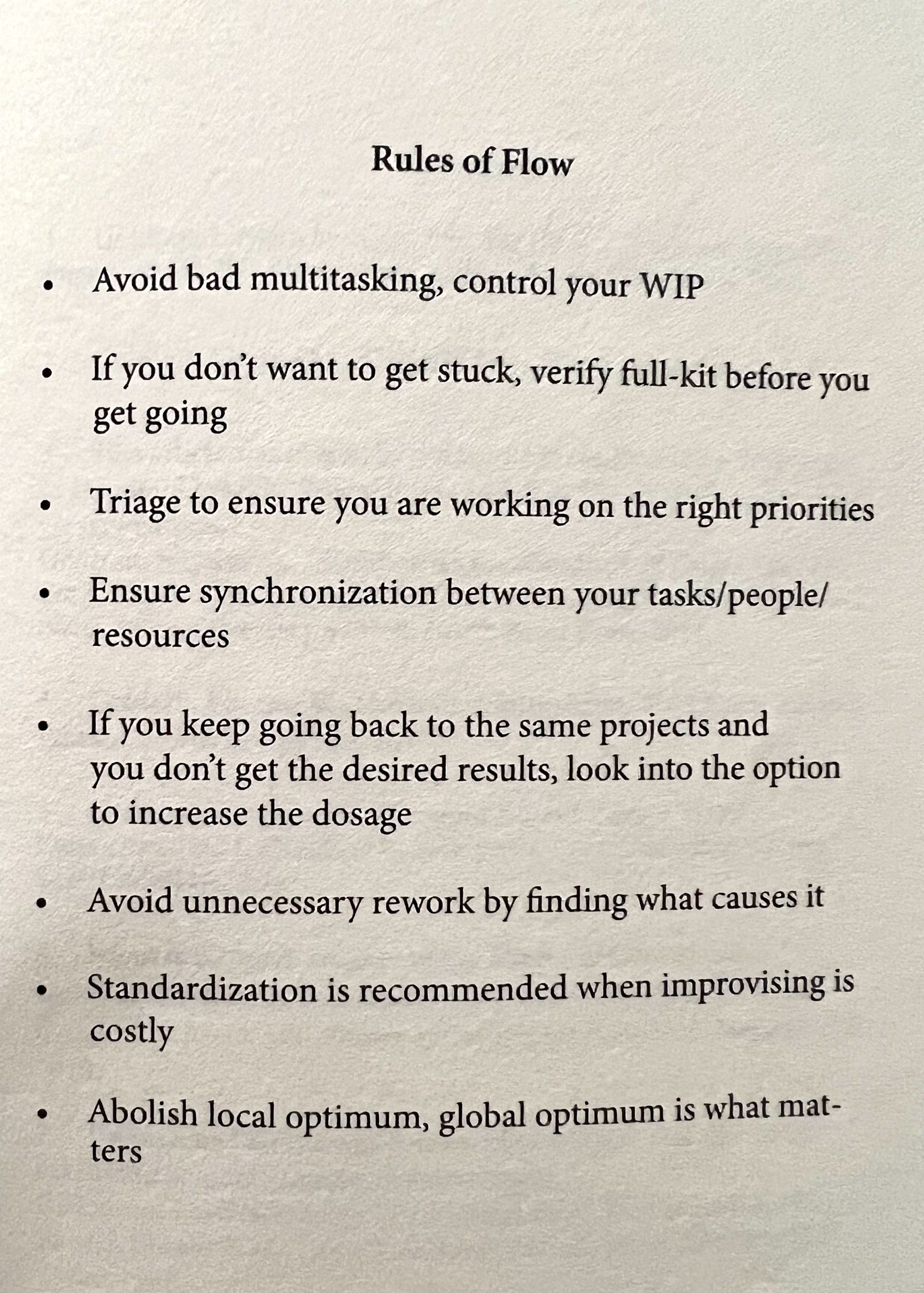
Goldratt’s Rules of Flow pushes the theory further into modern engineering, IT and service organisations. It summarises eight pragmatic rules - avoid bad multitasking, verify full kit, triage work, synchronize resources, increase the dosage for recurring problems, avoid unnecessary rework, standardize where improvisation is costly, and abolish local optima. Taken together, these rules form a simplified operating system for throughput‑driven projects.
Key Concepts in Critical Chain and Rules of Flow
Here’s a quick run‑down of some of the mechanics that show up again and again:
Identify the constraint. In any project there is a resource, skill or policy that limits throughput. Find it and elevate it; strengthening non‑constraints won’t strengthen the chain .
Student Syndrome and Parkinson’s Law. When we pad every task, people procrastinate and polish. Student Syndrome refers to waiting to start until the last possible moment, while Parkinson’s Law notes that work expands to fill the allotted time .
Aggregated buffers. Instead of hiding safety in each task, CCPM pools that contingency into a project buffer. A single aggregated buffer reduces the total time you need and prevents local padding from delaying the whole project .
Remaining‑duration reporting. Rather than asking “What percentage complete are you?”, CCPM emphasises remaining duration and buffer burn. Percent complete is notoriously misleading-90 % done can stay 90 % forever .
Feed buffers and fever charts. Feed buffers protect the critical chain from delays in noncritical workstreams . Fever charts plot buffer consumption against critical‑chain completion to provide a visual early‑warning system .
No multitasking on the critical chain. CCPM advocates strict discipline: when you’re working on a critical‑chain activity, you don’t pick up another task at the same time .
Want to dive deeper?
Before we get to the album, you might enjoy this excerpt from Critical Chain. It’s from Chapter 11 and lays out why managers must focus on the weakest link and how local improvements often leave overall performance unchanged . The excerpt is a fun, novelised discussion between professors and industry guests, and it hits on the need to identify the constraint before trying to fix everything at once .
➡️ Read the excerpt (free on the publisher’s site).
Introducing Full Kit Rock
Below is a track‑by‑track tour. The titles are deliberately blunt - my inner Ramone (and my AI writing partner) tried for clarity over cleverness.
The Whole Is the Goal (The Whole Damn System)
We open with the big idea: the goal isn’t for your team to finish faster or for your department to look good. It’s for the entire system to deliver more. Local optimisations don’t strengthen the chain . The chorus nails it: “The whole is the goal / the whole damn system.”
Stop Starting, Start Finishing
Too much work‑in‑progress kills flow. Four people running eight sprint tickets at once means nothing actually ships. This song argues for controlling WIP and focusing on finishing before you start something else.
Fix the Blocker, Not the Noise
When everything is urgent, how do you decide what to do first? Triage isn’t about volume or politics; it’s about picking the work that unblocks flow. This track is a reminder to address the real constraint instead of the loudest complaint.
Full Kit First (Show Me the Full Kit)
Ever started a DIY project and realised halfway through that you’re missing parts? That’s life without a full kit. This tune calls for a pre‑flight checklist: names, decisions, specs, test environment—everything you need before starting so you don’t stall mid‑task.
No More Secret Safety
Padding every task with extra time doesn’t make projects safer; it invites procrastination and polishing . This song explains why hidden safety gets eaten and how pooled buffers fix the problem .
Your Schedule Is Lying (Build the Real Chain)
A traditional Gantt chart ignores resource availability. It assumes the same person can be in three places at once. This track teaches how to build the critical chain by counting scarce resources and dependencies - no fantasy scheduling.
Percent Complete Is a Lie (Show Me the Buffer)
You’ve heard “we’re 90 % done” too many times. This song argues for using the buffer burn and remaining duration to track progress. Percent complete is for suckers; fever charts are your friend.
Don’t Break the Relay
Once the critical chain is in motion, it should move like a relay race: start when the baton arrives, finish without delay, and hand it off cleanly. The song emphasises resource buffers and synchronising work so finished tasks don’t sit waiting .
Increase the Dosage
Ever fix a problem only to have it return like a villain in a horror movie? Sometimes the remedy is too weak. This track encourages you to increase the dosage - give the issue more time, more expertise, or a stronger gate - if it keeps coming back.
Stop Paying Twice
Rework is work going backwards. When requirements change after coding or tests are written after bugs, you’re paying twice. This song calls for standardising the repetitive traps while leaving room for judgment where it creates value.
Bonus: Ask Until They See It
Goldratt’s novels rarely preach; they ask questions that guide characters to discover the answers. The bonus track honours that. Instead of lecturing people about constraints, ask them where the work is waiting, what happens when safety is hidden, or what one expert being on five projects does to a schedule. People defend processes you hand them; they fight for conclusions they discover .
One More Thing…
If the idea of learning project management through song makes you smile - please share this with others. I’m proud to give Goldratt’s ideas the driving urgent rock backbeat they deserve. And if you pick up the Critical Chain Book and recognize yourself in its characters, drop me a note in the comments. After all, the goal of this random walk through tech (and project management) is to make your journey a little less random.
Below is an excerpt from the last page of Goldratt’s Rules of Flow. Itself worth the price of admission to the book