
Defying Gravity with Antigravity
A lot of yakking with a little commentary on my post-honeymoon Antigravity experience.

Any sufficiently advanced technology is indistinguishable from magic - Arthur C. Clarke
No wizard that there is or was is ever gonna bring me down - Defying Gravity (Wicked)
Musicals? Again?
I probably should explain why I’m quoting another lavish broadway musical. So soon after my recent Frozen 21 execution theory article. If you’ve just come back from the future in a time machine after reading my epically successful memoirs then you’ll know that I’m not a fan of the genre. One never fully recovers from the childhood trauma of exposure to the Annie cast album at an impressionable age.
As with many confounding contradictions there is a reason.
This past weekend I went through a parenting right of passage I’m sure many have walked before me. Taking my daughter and her friend to see a movie. We’d seen Wicked together twice last year - so obviously we had to see the new movie and how it ended2. At some point I caught the contagious earwig that is the undeniably catchy song, Defying Gravity. Since I’d been using Antigravity a lot since last week my brain got silly with the (perceived by me) similarity. Even if Google’s intention for their IDE name was “it’s going to turn your world on it’s head3” and not a reference to flying witches.
Getting hang out with them was a great experience. I was especially proud when my daughter politely shushed her friend who was trying to talk to her at some point during the movie. I’d been encouraging that seriously, “no talking or screens” attitude in her since our first movie experience together (she was barely two at the time4). I’m not generally one for dogma (or zero tolerance) but I make an exception in this case. The sanctity of the cinema chapel must be absolute. If you’re not a member of the Church of Alamo Drafthouse on this issue we can agree to disagree. But please attend a different screening than me.
Don’t worry - we’re about to get on with the vibe coding stuff without further delay.
Antigravity - the post honeymoon experience
Last week I shared some initial impressions of working with Antigravity and Gemini 3. The TLDR was that
it let me do agentic coding stuff that had never worked unattended before,
I sort of liked the “we’re just gonna do this” attitude, and
it seemed to as the kids used to say “just get shit done.”
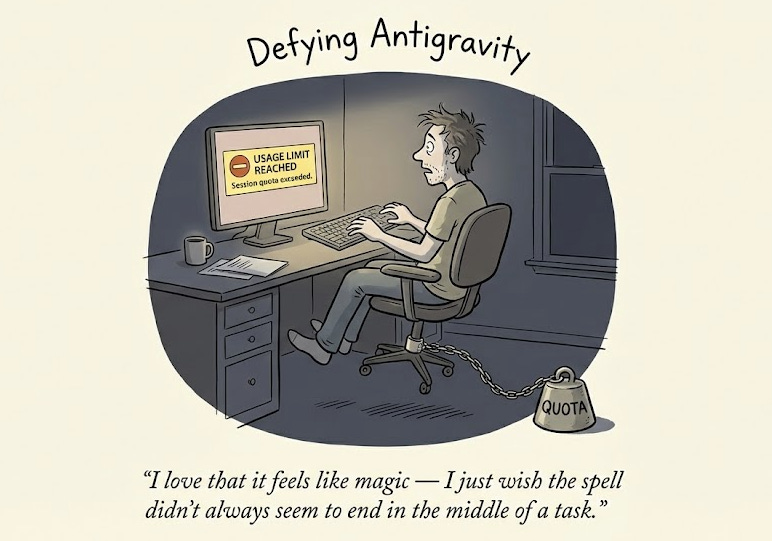
Now that I’ve had another few days to hack, it turns out that a technology can be both indistinguishable from magic and at times as annoying as heck. In this case there’s mental whiplash between joy and frustration. The largest frustration surfaces at 1:32 am as I wonder “WHY WON’T GOOGLE JUST TAKE MY MONEY!?” when I dutifully log in and and try to milk another few turns out of Gemini 3 on Antigravity under their random seeming quota system.

My exploration with Google’s tools has been targeted; heavily front end weighted, very much a solo developer vs. team (or teams of teams), and frankly I hadn’t actually read the manual.
I’m still loving the Gemini 3 / Antigravity combo. But the honeymoon is a little over. Some high level observations on my experience;
It’s very easy to run through the quota in < 15 minutes without even spawning multiple agents (sometimes in less than 5 minutes). Maybe I’m doing more sophisticated things, or more likely it’s a zero sum token game with Google as more folks have taken Antigravity for a test drive. It could have sworn my usage was a lot closer to the (I believe) advertised “generous usage limits” when I started last week. I know I shouldn’t be complaining about “free.” But it’s hard to stop once you start rocking.
Again, I LOVE it, but every day I’m more surprised Google didn’t have a plan to impose some predictability to when you get cut off. If not at launch, then soon after. This forced me to be more open to mixing and matching models within Antigravity, which in ways that maybe aren’t actually ideal for Google has seemed helpful. Though I’ve only been doing that for a day.
Can’t say enough how much I continue to enjoy that I don’t have to continually control-C (or the modern equivalent) it’s ass to keep it from randomly committing stuff5. This may be a settings/prompting mistake I’ve been making with Claude Code - but it seems to happen a lot to me without constant reminders there.
An unexpected work/life balance upside - it’s good for enforcing breaks when you’re kicked out of the Gemini 3 model. But when the core agent literally stops in the middle of a set of tasks it’s very much not confidence inspiring. After some initial reluctance on my part I’m experimenting with using the Sonnet 4.5 model option for a subset of tasks. It’s not at the same generation, so it’s not “best of the best vs. best of the best” but it’s pretty intriguing to switch back and forth, something I will be doing more intentional experimentation with.
It has been so fast and effective that even though I hate being rate limited in the middle of something I feel somewhat addicted to waiting and rolling the dice again (related to the model switching dilemma above). I’ve been realizing though that I should probably use the spare time this creates to better understand what’s available to a power user of Antigravity.
I feel a need to do more focused backend work with Antigravity/Gemini 3 to see where the system strains. I’ve mostly been doing a front-end application. Gemini 3 still did a great job helping me out with other systems decisions such as choosing and configuring a continue build/deployment mode, and enabling an authentication system (Clerk.com6 worked very wells so far).
I haven’t had the opportunity yet to point it at a giant legacy codebase and pair-program/learn with it as I did previously with Claude Code. So there’s still lots to discover about that capability7.
Those all mostly read as positives - which is my general view. Beyond the rate limiting the other issue when I finally hit it was just a bracing ice bath of reality. Even with what seems like a razor sharp model, I’ve now seen many many times where Gemini 3 acts like any other LLM. Put nicely that means it does batshit crazy things that are obviously wrong to a skilled developer. The assumptions / jumping to conclusions is an ongoing battle. Once it seems to get started down a wacky path, just like other models it can take some hitting it over the head with a baseball bat to get it back in line.
In practice this means things going along swimmingly, but then all of the functionality just disappearing and the model going in circles for a while trying to figure out what happened to a </div> closure - often in the most complex possible way. While at the same time I’m begging it to slow down and reason about why it rewrote the whole section for a “four of five things work and one doesn’t - they’re all the same conceptually so can you look at what’s different about the broken path?” Ah … good times!
I’m still super pumped to keep playing with the IDE in particular. I have lots to uncover within it’s magic. Just today I noticed that if you are doing spec-driven development8 (which you should) it natively lets you add comments to the spec just as you would in a Google doc. Then you can just submit it back to the AI and let it respond. Once things are dialed in you can ask it to built it. Very nice touch.
As I’ve been thinking over and over again - it probably really pays for me to read the manual!
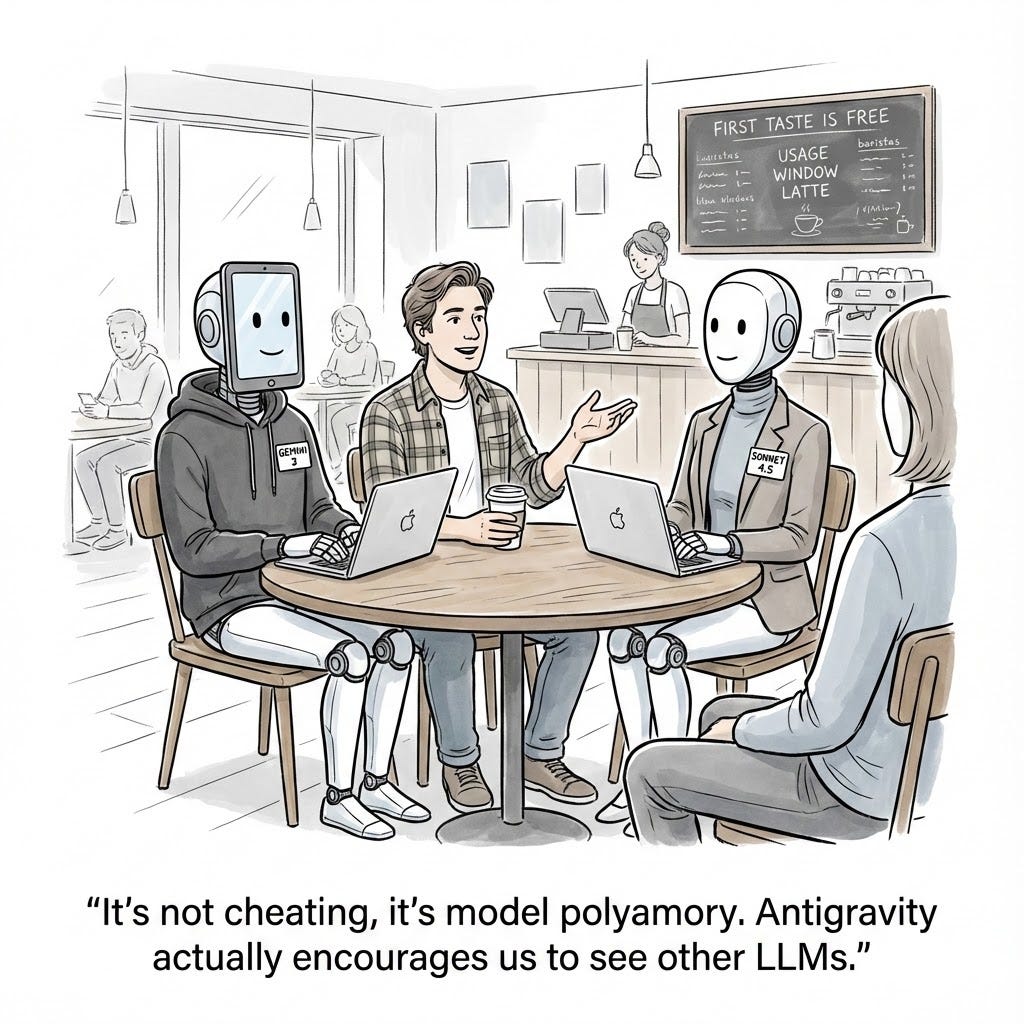
The first taste is free
If one puts on their speculative “evil product manager hat” it’s possible to imagine reasons for some of the Antigravity quirks. Such as the inability (at least to the extent I can see) to know when you’re about to get cutoff, the specific messaging as when you can log back in for your “next fix”, and the cutoff of both Gemini 3 models at the same time (as opposed to falling back to the less capable one).
I’d assumed that the Antigravity team wanted to get their IDE out in a way timed to draft off the Gemini 3 launch - and thus were willing to not have everything in their go to market buttoned up. But idle hands are the devil’s workshop - and every time I’m grooving and get rate limited I have time to ponder the “why” of the delay.
This period of forced reflection often has me staring at this screen trying to will the little yellow stop symbol away.
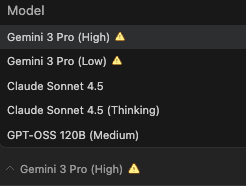
I’m not entirely sure why - but the first two times I thought “really, why would I want to switch models now while things are cranking?!” A crazy thought though flashed by at one point - “what if this is a genius scheme to get me to compare Gemini 3 to the older Claude model9” Conditioning my entire belief system away from the Anthropic ecosystem. Genius - just next level, build your secret base in an abandoned volcano with your own monorail level Genius!”
Then I realized maybe I was cracking up, and it’s likely good to have these forced timeouts. Regardless, today I decided to trundle on and use Sonnet 4.5 during these periodic breakups for basic tasks and just send Google’s genius PM the bill from Anthropic10.
One nice benefit of this it it’s forcing me to use Antigravity decoupled from my belief that the indistinguishable magic part is all coming from Gemini 3. It turns out that I like aspects of Antigravity in a model agnostic way. Again though - it’s reminding me I really need to read the some of the IDE documentation. I’m especially keen to checkout their agent assignment and orchestration system. No, not because I want work in an “I am the puppetmaster” comment into a future article. OK, not only because of that.
Summary, and a brief caveat
I think we’re all figuring this out together. I would say 80% of me writing this was to get some of my own experiences straight in my own head. 15% of it comes from a hope that someone will read this and explain - “you’re completely and utterly wrong about ____ and this is how to do it.” 5% is a belief that maybe part of it will be helpful, or at least entertaining to a like minded soul.
After finally experiencing the smart intern who just decided to try meth on the way into work situation (which was in hiding at first) I’m still pretty sure professional engineers have a career path for a while. Partially because I’m now sure that even this monstrously impressive Gemini 3 can’t be fully trusted to take the family station wagon out unsupervised. Definitely not to be trusted with Cameron’s dad’s Ferrari. But also because I still have an inherent belief that engineering is bigger than any one tool - and is a discipline that sits beyond, above, or at least alongside any one particular set of execution skills.
Though just in case I’m wrong, I need to get back to working on my apocalypse bunker and prepping. Oops - I mean figuring out the movie schedule for the holiday weekend.
Also - don’t worry, I know this makes 2/3 of the last articles in some way about agentic coding. I assure you that this isn’t turning into an ill informed guy writes about vibe coding Substack. I’m sure there’s enough of that if you want it in your LinkedIn feed. I’m gonna get busy finishing stuff from my systems/management/personal effectiveness backlog next.
Post-credits scene
OK - I tried switching to Claude Sonnet when my free usage window ran up. It worked pretty well, and it does have the benefit of forcing me to look at Antigravity as a separate product. I’m not going to send it something of high complexity - but once the basic structure is in place it executes a spec decently well. Plus it’s fun to hang with Claude’s personality which I’ve gotten fond of given how many hours we’ve spent together. Then as the clock swung back into my Gemini 3 availability period, I realized I could try this: specifically asking Gemini what it thought of Claude’s plan.
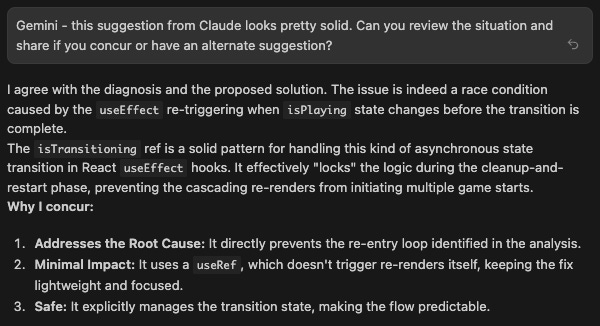
Turns out this seems to work nicely. So now I can talk to myself alongside my two robot buddies. The future is truly so bright I might need to wear shades. Though in a literal sense, not really. This is Seattle in November.
[If for some crazy reason you’re reading this close to posting: Happy Thanksgiving everyone!]
Yes - I know Frozen 2 is not technically a Broadway musical. But it’s a musical, and as you’ll see in literally the next sentence, I’m not generally a fan. So, apologies with playing fast and loose with the semantics of the genre or whatever. ;-)
FWIW - I had a better idea than she did what the end game might look like, since she refuses to see The Wizard of Oz. Though I have to say things did turn out a little differently than I expected. Leaving The Doors one of a small number of films where I was 100% sure of how it ended, and was actually correct.
I’m assuming this was the reason. Please don’t spoil it for me.
Seattle Children’s Film Festival at NWFF. Highly recommend.
Yes - I’m looking at you Claude Code.
They’re crushing it as an authentication product - but totally failing in the category of making obvious references to the movie Clerks. I mean there’s not even a single “I’m not even supposed to be here today!” comment on their homepage.
If you have one to volunteer, maybe let’s talk.
This is somewhat just a fancy pants way of saying that you should have the AI help you write a spec first and then have the AI work from that spec. Or as I keep reminding myself - almost everything we’ve thought was true about velocity and quality before is still true. Just done somewhat differently. But maybe not really.
Arguably the fact that as I wrote this quickly I actually forgot that Sonnet is the older version of Claude model ecosystem (or the “less capable” for coding one) in the original version of the article perhaps supports the conspiracy theory. Or that I’m forgetful. Or that TBH there are way too many model names about.
oops - updating a day later. It turns out that Sonnet usage also has a limit. It’s reasonably useful when I have to wait - but it’s not exactly a gangbuster choice. Since I’m actually paying Anthropic I will spend some time with the new Opus 4.5 next.
Love this perspective, especially how you brought in Arthur C. Clarke's quote; it trully encapsulates the feeling when working with groundbreaking tech, something I try to impart to my CS students. It's fascinating how the concept of 'defying gravity' or 'turning your world on its head' resonates so deeply with the potential for human innovation and progress.